Showing posts with label personal development. Show all posts

Thursday, January 13, 2011

Forget the Science Fair, it's a Science FEAR

I'm standing one step away from the annual childhood ritual of the science fair and I have to say, it's really a strange rite of passage with (to me) fairly limited educational benefits.

How can I count the ways this thing makes little sense to me? Well first there's the wholesale application of the scientific method. With all due respect to the scientific method, this is not something that is easily learned, certainly not by eight year olds! The steps of the method, listed below, may seem quite simple, but at 8 or at any age and with any kind of learning disability, some significant effort has to be made to make these principles accessible. My question is: why make an experiment, requiring the application of all 6 steps of the method a requirement at the second grade, especially when there is little likelihood of the teacher having covered all these concepts?

Why not create a science fair system that begins with teaching the importance of formulating questions? Later, the teachers can graduate to incorporating doing background research, still later graduating to formal hypothesis generation and hypothesis testing. With each passing year, as more is taught, students are better able to apply more and more of the method to their projects. Projects could then become more elegant and more learning would take place. With such a process, the curriculum would remain accessible and the learning would be lasting, the whole point of education.

As it is, it seems to me that asking an 8 year old to 'construct a hypothesis' is ridiculous in the extreme. It is entirely possible that my perspective is informed by the challenges of our second grader. Her problems with formulating and asking probing questions are a function of her ASD, but I'm fairly certain that she isn't the only child who, in the absence of sufficient teaching, can't figure out what a good scientific question might be. How hard would it be to actually, I don't know, teach the thinking involved in science? How hard would it be to expose the children to these concepts in ways that make science more enjoyable rather than more terrifying?

What I most resent is the way the whole science fair is set up, such that it seems only to serve two negative purposes. First, it serves to alienate children from science. I've heard stories of parents who simply recycle projects from one year to the next. Where's the learning in that? What are we teaching our children? It's definitely not the rudiments of science, more likely it's the rudiments of cheating. The second purpose that seems to be served here, is that the system inadvertently alienates children from their parents. If a parent is a high school graduate with little science exposure, how does she/he help the child and if she/he can't, how does that make her/him look to the child? Further, how does that help the education system achieve its goal of engaging parents in their children's education?

The whole thing seems a terrible waste of time and emotional energy to me, but that's just me. Oh and at the end of the day, it's the parents doing half the thinking behind the output. What's the point of that?

============================>

The 6 steps of the Scientific Method:
  • Ask a Question
  • Do Background Research
  • Construct a Hypothesis
  • Test Your Hypothesis by Doing an Experiment
  • Analyze Your Data and Draw a Conclusion
  • Communicate Your Results

Friday, January 7, 2011

Seeing and believing

Who hasn't been Ted Williams at some point in their life? Perhaps our moment of 'Ted-ness' didn't take us to the streets, but who among us hasn't drifted far off the path we envisaged for ourselves?  Who?

While we revel in the joy and excitement of Williams' new found hope and prospects, perhaps we should take a moment to consider that it is the fact of his having been seen that has given him this chance. Perhaps we should consider for a moment, that every day we pass folk on the streets (and in our homes?) who only want to be seen.


Seeing isn't nearly as hard as it might first appear.  It involves putting down the iPad, iPhone or other smartphone for a minute and making eye and emotional contact with the person right next to or in front of you.  Think about it.  Not too long ago, there were no gadgets to keep us as connected and yet disconnected from our neighbors.

Everywhere you go today, when you see someone down on their luck or just experiencing a rough patch, someone who is clearly in need of a hand, perhaps you might ask yourself, "Are you Ted Williams?" and follow that thought with whatever action you think is appropriate.  Maybe you'll buy someone a cup of coffee or put someone in touch with a coworker looking to fill a job.  Ted Williams isn't the only diamond out there waiting to be found and polished, given an opportunity to be set into a spectacular piece of jewelry.  No indeed, given our almost 10% unemployment,  you can rest assured that there are quite a few Teds out there.

Commit yourself to seeing and believing in someone today.  It's really not that hard.

Tuesday, January 4, 2011

Happy New Year!

At the end of every year, I consider how things have gone over the preceding twelve months. Over the last three or four years in particular, I've not wanted to peer too closely at things as things haven't progressed as well as I would have hoped. 2010, though was quite a departure. Perspective is a heckuva thing.

Though by many measures, I haven't done all that I would have liked, I was blessed to complete a project which, frankly, I've been wanting to complete for about 5 years.  Instead of being hampered by unemployment, I was freed by it.

People talk all the time about how being fired or downsized opens up new vistas, well, it's true for me as well.  As a consequence of the blessings of 2010, economic uncertainty notwithstanding, I see 2011 as an open year, brimming with new opportunities.  For once, I don't see the closure of a bad year but rather the opening of a great one, greater still than the one just ended. 

I'm very excited about 2011.  I hope you are too.  Happy New Year.

Monday, December 20, 2010

Free-Range Thinking

I'm fascinated by the hold that the notion of "thinking outside the box" has on business speak.  I wonder if anyone has taken a moment to consider what the converse of that might be. I would imagine that having considered the converse, TOTB would be considered de rigueur and we could, maybe, stop talking about it as though it were some great and wonderful thing instead of the most natural thing in the world.

What is a box? It's a container.  It is a thing limited in size and capacity.  But what is a thought? It's an idea or notion.  It may be transitory or permanent depending on the thinker's evaluation of the idea.  It is as wide or as narrow as the mind that thinks it.  It can be unlimited in size and capacity depending on how much energy its 'owner' gives it.  So here's my question: why in the world, would I squeeze that which is, by nature boundless into any container that is by its nature, bounded and therefore constricting?

Humans seem to like little sayings that embody general truths or perhaps it is tag lines that we like as they help us better understand the world.  TOTB has become a favorite tag line, a hot phrase that folks use when the limitedness of limited thinking is finally beginning to show in business and organizational performance. So here's my big idea: why not start with unbounded thinking? Why not start discouraging boxed thinking and start encouraging free-thinking, in all times and all places?  Why don't we all just start thinking freely and letting others do the same?

It occurs to me that the idea of thinking outside the box is at its core, about empowerment.  Empowered folk naturally think outside the box because they're free.  They are free to do and be whomever it is they are.  Boxed folk, on the other hand, have to be encouraged to think freely.  So here's my advice: get a box cutter, cut the box to shreds and then just think. And don't be afraid to share the thought.  Waste little time dissecting the thought down to nothing.  Just think.  It's quite liberating.

If free-range chicken is good, can you even imagine how good free-range thinking might be?  Try it some time. That's what I'm going to be doing (more of) for the New Year: Free-range thinking. Now go on and open up that box.

Monday, December 13, 2010

Sense before Self, Wisdom before Wants

I appreciate that there's a lot of pretty stuff in the stores. I'm partial to Talbot's and Ethan Allen myself.  I imagine, if I spent more time in the world looking at the pretty things out there, I might be drawn to shop til I drop, engage in a little 'retail therapy'.  Fortunately for me, I'm not.  I'm not out there and I'm not drawn in to the endless rounds of shopping.  Not even at Christmastide do I feel a need to be spending wildly, but that's just me.

I do wonder though, the extent to which the crazy 'shop, shop, shop' culture (including the 'shop it's good for the economy' nonsense), plays a role in the tendency of executives of all stripes to make illegal and immoral decisions.  Take for instance, PG County (Maryland's) own Jack Johnson.  It is alleged that Mr. Johnson has had a pay-to-play modus operandi in the county.  It is alleged that if one wanted to build a store, one had to offer tangible financial support to his administration (or to him personally).  It is alleged.

None of this is really surprising in a culture that deifies money and the things it can buy.  As I said, I too would love to spend more on pretty things, but at the end (or perhaps the beginning) of the day, when we replace integrity, honesty and decency with an ends-justify-the-means mindset, trouble surely will follow.  That's not news but clearly, it bears repeating.

As for Jack Johnson (a former state's attorney (the chief prosecutor for his state)) and his wife (herself a former attorney), neither of them even has plausible deniability to fall back upon.  Allegedly, Johnson was heard on a federal wiretap advising his wife to destroy a check in the amount of $100,000 and to hide $80k+ in cash on  her person, even as the FBI was knocking at the door.  Surely one or the other of them knew that they were on the wrong path, well before the FBI was at the door? 

So here's the memo: Jail ain't fun and most of those who land there don't generally return to their earlier lives untainted by the trip.  While Martha Stewart was able to move smoothly back into her empire, Mark Madoff (Bernard Madoff's son), who was never even acccused of any wrongdoing, was not so lucky.  Sometimes even the merest taint of impropriety is enough to completely derail a life.  That should be warning enough for the sensible.  Jack & Leslie Johnson clearly didn't get that memo.

Wednesday, December 1, 2010

Learning to Roar at Home


Some weeks ago, I had the pleasure of attending a concert/service at my new church, celebrating the 225th anniversary of the birth of that congregation.  I don't know whether the intent was for the concert to be a spiritual experience but it certainly was for me.

About halfway through the program, a young woman sang Helen Reddy's "I Am Woman", the first line of which goes: "I am woman hear me roar, in numbers too big to ignore".  The program had been arranged by historical era, so as they were describing the church during the era of the battle for women's rights, this was the featured song.  In the moment, my sister leaned over and said something to me about our great-grandmother's sister, Texelia Pierre, and it occurred to me that I'm one of the fortunate ones who has lived with roaring women my whole life.  It occurred to me that like a lion cub, I learned to roar at home, from the women in my family.

Sometime in the middle 1800s in the Caribbean island of Trinidad, my great-great aunt Texelia Pierre left her (according to family lore) worthless husband because he wouldn't do right.  What that has meant for the females in succeeding generations is that one doesn't simply have to put up with some do-nothing man, or some go nowhere job, one can simply strike out on one's own.  What a legacy to leave to one's female progeny! Would that I had earlier realized the freedom it gave me in every area of my life.

That a black woman in the late 1800's, in the tiny island of Trinidad, educated only with the power to read and write at Elementary level would have the strength, the intestinal fortitude, to decide that alone was preferable to being married to a dolt still astonishes me today.  Not that I wouldn't do the very same, but I'm much more educated than she was and have options that I know Texie didn't and yet it is she who struck out on her own.  Fearlessly.  Me, I'm not so much fearless as fearful.  The lore, if I recall it correctly, was that she became a merchant of some kind but the details were always a little sketchy and I didn't have the good sense to pump Granny for greater detail before she left us.

So my question is, not what's in your wallet, a la Capitol One, but rather, what's in your being? What's in the fiber of your being, handed down through the generations by your mother and your mother's mother, and your mother's mother's mother (or sister).  Apparently, gumption is in mine.  Gumption. Who knew?

Friday, November 26, 2010

Vitriol's Lure

I've long known that I write better when I'm angry.  The thoughts come together quickly, the logic is crisp and the anger gives a certain sharpness to the delivery that I think makes for better writing.  Perhaps though, what I've been experiencing is that passion (of which anger is but one presentation) makes your best more accessible.  Perhaps this explains vitriol's lure?

I've been wondering a lot lately about vitriol particularly because there was so much of it about in the election season and traces of it remain everywhere.
Endless streams of invective are aimed at folk who don't think or frankly, talk, (or, let's be honest, look) like you.  It's wearying and not terribly effective as a form of discourse.  But that aside, what is clear is that vitriol sells.  It sells books, moves the proverbial needle of public opinion and these are the things that matter apparently. 

I have to wonder sometimes whether the intent of some of the utterances we hear and read is to educate or just to irritate?  Folk like Rush Limbaugh make me wonder whether the intent is really to encourage others around to their way of thinking, or just to keep the friendly masses whipped up into a state of lather and frenzy.

My concern isn't directed solely at conservative thinkers, I recently listened to a very liberal gentleman speak (I don't remember his name), and all I could do was suck my teeth and turn away. The source of his distress was that nothing that had been achieved by the current President met his liberal standards.  At the time, all I could think was, "In what parallel universe America do you think that kind of law would have made it through this legislature?"  He appeared to be a complete stranger to that quaint notion 'compromise'.  Listening to him I suddenly realized that this country thrives on the diametrically opposing positions.  It's good for the newsmakers but not necessarily good news for the news readers.

Nothing seems to work in the middle here.  All view points must be on opposite ends of the spectrum.  Bookends.  Votes are cast for extremes of opinion and then extremes go up on the Hill and stake out their space.  Me over here and you, wayyyyyyyyy over there.  No wonder there's so much shouting.  I can only hear you if you shout.  I'm not coming to the middle so that we can actually have a conversation, and you're not coming to the middle so that we can actually have a conversation so let's just see who can shout the loudest.  Lovely.

The other reality is that voters, citizens, residents whatever you call folk on the outside looking on, crave entertainment so in steps vitriol to ramp up the entertainment factor and to vie for the ears and eyes of the voting public. Between the vitriol and the shouting, I've got a permanent headache.

Good luck getting anything done.

Saturday, November 6, 2010

Abs over Abstraction

Abdominals Pictures, Images and PhotosI have insight, The Situation has abs and a multimillion dollar payday.  One of us has got it wrong.

Months ago, I wrote glowingly about the Ford Motor Company and their billion dollar earnings in the third quarter of 2009.  I also wrote in Go Ford!, that it was clearly the vision and approach of the new CEO, Alan Mulally a stranger to the industry, that was primarily the cause.  This past week, I discovered through a series of interesting 'coincidences', that I was right about Ford and Mulally.  Yay me!  I'm happy to discover that my ability to draw insight from information (courtesy my expensive graduate school edumacation) remains keen and accurate.  Too bad about the payday though.

It's great to be proved right. I love it.  Who doesn't?  Unfortunately, at the same time as my insight about Ford and its leadership were being proven correct, in the news (OK it wasn't real news it was entertainment news, but bear with me), in the 'news' came word that The Situation (aka Mike Sorrentino) is making a cool cinq million this year on his abs, his public appearances and the Jersey Shore.  Me?  I'm not quite at cinq million.  Yet.  Maybe insight is NOT the way to multimillion dollar paydays?

I have to wonder, what exactly is it that is valued in this society?  Do note of course, that I'm not saying, 'valuable'.

That which is valued in a society, speaks to what makes sense in the general order of things in that society. So when abs are valued over abstract thinking, you have to ask yourself (or at least I have to ask myself), why go to school and get in to debt to gain knowledge which, while possibly valuable, is not necessarily valued?  I don't need to be educated  to have good abs.  I can get those for free.  (Incidentally, I do have good abs, but they don't seem to be adding a penny to my current compensation package.  Just thought I should toss that in there.)

Take a state like Michigan.  There, it seems to me, current unemployment is a function of the historical competition between the valued versus the valuable.  Because of the easy availability of manufacturing work in the past, folks left high school and went directly into jobs at the nearest automotive manufacturing plants making  $50k - $75k annually with excellent benefits.  In the past, those were considered good choices.  Higher value was placed on immediate good income over the higher lifetime income possible only after one had endured the delayed gratification a college education requires.

There and elsewhere people chose, and still choose, immediate over delayed gratification.  That it seems to me, is because there is higher value placed on $$ in the now, than $$$$ in the tomorrow.  Of course now that the economy in general,  with the manufacturing sector leading the way, is in a mess we see this choice differently but that's a story for another post.  Am I seeing this too simply?  Do I see a simple dichotomy of choices where something more complex exists?  I don't think so, but others might*. 

The President has made efforts to make tertiary education more accessible about which I wrote briefly some months ago.  The goal of those efforts is to take some of the financial motive out of the equation when considering whether or not to go to school.  Even before this, there were options available here that do not exist in other countries and yet, many do not avail themselves of those opportunities.  Why? Because, it seems to me, the media make it abundantly clear that that's not what is valued.  What is valued is notoriety (Lindsay Lohan, Snookie, The Situation, Paris (famous for being famous) Hilton) not knowledge.

The problem it would appear, is not access to school places, or access to funds for school,  but something else entirely. I haven't quite figured out what to call it but it has something to do with seeking validation from external rather than internal sources.  I could be as poor as a church mouse, but once my life of the mind is rolling along, I'm as happy as a clam at high tide on a warm day.  But that's just me.  Once I can write something of interest and value (even if only to me), my contribution to the universe is done for the moment and all is well with the world.  External validation?  What's that good for?  But that's just me.  I am enough.  But that's just me. Lights? Cameras? Mugshots? Don't need 'em.  I am enough.

And so it goes.  I don't know that The Situation or Lindsay Lohan is adding anything to the Universe that is likely to be lasting, but perhaps adding something of lasting value is the least of their concerns.  Both of them can go to Coach and buy a $3,000 bag.  I cannot.

++++++++++++++++++++++++++++++++++

* Lest anyone say that it was easy for me, suffice it to say that it was not.  I anxiously waited 11 years between degree number 1 and degree number 2 and did a number of crazy things (including running a taxi) to make the resources available to do my second degree.  Very hard choices had to be made.  Given the opportunity to 'do over', I'd make slightly different choices, but the outcome would probably be the same.  

++++++++++++++++++++++++++++++++++
One of those interesting coincidences I mentioned.  Here's CEO Mulally, talking about his leadership style at Ford.  Go Ford!!

Mulally insists on truth telling.  I LOVE IT!


\

Friday, October 29, 2010

Ethics vs Innovation. Competing commitments?

What a strange story!  I recently read on a blog an article about the tension between innovation and ethics and all I could think after reading it was that clearly I had missed something.  The author referred to an article she had read elsewhere that had caused her to make the intellectual leap that perhaps there was a tension between the two - innovation and ethics.  The trigger article is: If You Think It's Unethical It Probably Is,  written by Eileen Zimmerman which appeared in the NY Times on October 23, 2010.  You should give it a look. It's quite interesting.

Now that I've read Ms. Zimmerman's article though, I think I really must have missed something and I have to say that I don't quite understand where this tension between innovative thinking and ethics became an issue.  Ms. Zimmerman's article spends a lot of time talking about how to push back (without killing your career), if you think something you've been asked to do, crosses ethical lines.  Never does she suggest that there is a tension, nor indeed does she ever refer to innovation either covertly or explicitly in her writing.

To innovate (per dictionary.reference.com), is to "introduce something new; make changes in anything established".  Implicit in that definition is an understanding that that which is created is rooted in truth.  Perhaps that isn't implicit to anyone but me, but I fail to see how lying could be considered innovative, unless we are talking about taking an innovative approach to the facts.  An old choir director of mine used to joke about people who didn't know the music but would sing their own 'impressionistic renderings' of the songs.  That's innovation too I guess except it was greatly discouraged in the choir, as it should be in business.  Harmony easily becomes cacophony when people play fast and loose with the truth be that musical truth (the notes) or business truth (the numbers).

I am a big believer that innovation is the only way for an organization to stay relevant but I question whether anything that involves lying or otherwise misrepresenting the true facts of business performance could even be loosely categorized as 'innovation'.  I am also not sure that even on the keenest cutting edge of innovation it is necessary to compromise one’s ethics. I am certain that there are areas of scientific endeavor where the ‘edge’ goes beyond anything I can imagine, but where innovation challenges prevailing ethical constraints, processes usually exist to challenge those ethical lines.  Think back to the first IVF and the ethical debates that raged then.  Think now about stem cell research and the raging ethical debates in that field.  Innovation is all about challenging the status quo, but for those wishing to do so ethically, there are ways to challenge without stepping all over moral and/or legal boundaries.

In most businesses, it seems to me, where ethical lines are crossed it is not because of some wonderful, business-saving innovation that runs afoul of prevailing ethical norms (creating some mythical tension), but rather it is usually because of a blind and dangerous (just ask Wall Street) focus on a profit motive.

Once business people take their eyes off ethics and focus wholly and solely on profit margins, P/E ratios and market capitalization, trouble surely follows.  Innovation is not the enemy of ethics, greed is.  The tension really is between money and ethics.  Don't blame innovation.  She wasn't even there when the bacchanal began.

Friday, October 15, 2010

Cogito ergo sum

I've taken to saying that arch conservative Republicanism is a treatable ailment.  I'm working on a treatment protocol which I will roll out to market as soon as it's ready.  Here's the preview.

FIRST: Conservatism is not a free pass to speak hatefully.  By this I mean you cannot go around appealing to the lowest part of man - the troglodytic part - that needs, yearns even, for a person or group to point to as the cause of all their troubles.  While this may work in the short term, it will yield untold consequences.

It is said that in a court of law, an attorney never asks a question to which (s)he doesn't already know the answer.  The same should be true in politics.  Don't set something in motion unless you know exactly what it is you're setting in motion.  In short, don't be sowing the wind unless you are ready to reap the whirlwind.

SECOND: Underlying principles always rule. 

I certainly understand the worry about the deficit, but let me see if I get this right.  Deficit for war = good thing. Deficit for universal health care = bad thing?  When these ideas are juxtaposed, the underlying principle seems to be simply this: some lives are simply more important than others. If you can't afford or through some unfortunate series of events, cannot receive insurance then, tough, sorry, you lose.  If conservatives have a different argument they should really bring it but right about now, this is all I've been able to draw from what I've heard to date.  No one has said anything that makes sense and that doesn't sound like there's some human utility litmus test which some of us have failed abysmally.  Conservatism is not a free pass to deem some people less worthy than others.

In short: 'Conservative' cannot become a euphemism for 'hater'.  

I'm recommending that conservatives try and come up with some reasoned positions that appeal to thinking people - people like me who are ripe for the picking.  It is far too easy to fall back on traditional 'them vs. us' thinking and speech.  That's pretty much what started the ugliness in Germany and gave rise to Nazism.  Since we know how that turned out, perhaps we shouldn't try that whole "it's their fault we're in deep doodoo" approach here?   That's an approach that encourages hateful behavior which, quite frankly, is beneath thinking people and a thinking nation.

I am myself, fairly conservative fiscally, though you probably wouldn't guess that from anything I've written thus far.  I too believe in responsible spending and in spending what you have and no more.  Debt has its place, but great gobs of it only create stress.  At the same time though, I believe in the sanctity of life.  This means that if I have to balance debt against death, I'm going to have to grit my teeth and live with the debt.  A right to life necessarily means that people also have a right to health care.  If that means that something else has to give (maybe a war here or there, particularly one entered into on spurious grounds), then that's how it has to be.

This political system is, unfortunately, built on a two bookends premise.  Either you're a 'this' or you're a 'that'.  Even Independents are either 'thises' or 'thats' in the voting booth.  If you don't like how the 'thises' are functioning, you vote for the 'thats'.  It seems to me, that there's a middle ground, where people want responsible (not reprehensible) representation; a middle ground where representatives appeal to our highest aspirations for ourselves (which should also mean that our aspirations for each other are equally high); a ground where we spend what we have, make hard choices about what gets cut and each take on our share of the burden for what's left.  That's a pretty conservative credo if I say so myself, and not once did I say, "Death Panel".  See how easy that was?


Tuesday, October 5, 2010

The Power of Lack

A week or so ago, I was talking to a friend about various things, and one theme that emerged from our discussion was this idea that lack, shortage, challenge - primarily financial in nature - can be a source of great growth and self-discovery. So as we were chatting about various 'lacks' in our respective Universes, my friend used this turn of phrase, "the power of lack" and I realized that in  my life, for all the stuff I have been denied through an absence of disposable income, I have been given so much more.


In my family, we rarely had the latest outfits, but we had all our school books.  An opportunity to be educated = Abundance.  We didn't get a ton of Christmas presents, though we certainly got many, but many Christmases, our grandmother had a Christmas Eve dinner party.  An opportunity to share even the Widow's Mite = Abundance.  Everything on the menu was home made including the menu cards themselves.  I'm sure if I ask my sister, she can find one of the menu cards with the little turkeys Granny made us draw one year.  Every item on the menu was named for a person attending the party.  An opportunity to share one's creativity = Abundance.

Our Granny also insisted on having her lady friends over to tea periodically.  I don't know that there was ever a particular event (no anniversary or other celebration), it was just Granny entertaining her friends.  We rudely referred to these events as "old lady tea parties", but we attended gleefully all the same.  We were required not only to serve but also to be the entertainment.  These were my first (unpaid) gigs as a singer and this gift, the ability to sing for others, which my Granny inculcated, is a gift that keeps on giving abundantly.  My sister and I sang, my cousin recited poetry and Granny and I played duets on the piano. 

We may not have had endless pretty new clothes or fancy shoes aplenty, but there was some serious emotional, personal and spiritual abundance in my home.  Perhaps this is what makes it possible now for us to see only opportunity even in the face of myriad challenges.

The question I have to ask myself now is: was there really any lack?  I'm sure my mother and aunt can list bills that they struggled with and things that they wanted to do for themselves that they were unable to do, but in truth, it would seem that all we had was abundance.  It just goes to show, that once you take your eye of the 'stuff' of life, you can find yourself overwhelmed by how much 'life' you really have.  I know I am, overwhelmed that is, by the abundance in my Universe.

Monday, October 4, 2010

Win, lose or draw, I'm leaving it all on the field

I've determined, and I've said this before, that the voices in our heads have to be heard.  On my first Friday at home, I attended a friend's church where the Pastor preached on exactly that.  His title was something of the order of "Listening and responding to the Prophetic Word".  Whether you're a believer or not, I think we have to accept that ideas - whether crazy or brilliant - come to us in a flash and that it is in the response to the flash that we sometimes lose our way. What happens next depends on a number of things, not the least of which is our belief in ourselves and the level of support we feel coming from those around us.

For more than 20 years, I've had this one recurring idea.  It hasn't been my only idea, but it is the one that drives and needles me most. I finally had opportunity to give it voice 12 years ago.  The reason for the lag was that I had had the idea when I was about 20, but was too low on the family totem pole to be allowed a voice (a story for another blog entry altogether).  At 33,  I was able to have it received and acted upon.  It is entirely possible that the fact that I'd been to university and was a successful professional by that time, made my voice *clearer*.  Whatever it was, there was a confluence of unhappy events that made it possible for me to be heard. It's been more than a decade since then, and my subsequent series of ideas have not be welcomed with nearly the same fervor as there has been no confluence of events, sad or happy, to support my insights.

Having finally grown weary of waiting to be heard, Waiting for Godot as it were, I've decided to do my thing without family blessing (again, a blog post for another day!).  When we believe in ourselves and our ideas, we do what we must to make the visions in our heads reality.  We talk to whomever we must, we needle, we cajole, sometimes we shout and then finally, someone hears and we are able to do.  This I have done.

I heard a joke/story recently of an older wise man asking a youngster if he wanted to succeed as much as he wanted to breathe.  [Given that the youngster had just had his head dunked and held underwater, he understood the level of commitment that would be required if success was to be his.]  That's me with this recurring idea: I want it as much as I want to breathe.  I recommend that kind of commitment highly though I'll be the first to tell you it ain't easy, I'll never say that it is, but it is worth it.  My current exhaustion attests to that fact.  I'm just back from the field of play and I'm worn out.  My exhaustion is honestly earned though because I've given it everything I had in me.  I've left it ALL on the field.  Win, lose or draw, I went out and played hard.  I'm bound to get some points for that.  As a matter of fact, I think I already have.

Friday, September 3, 2010

Up and down

Several months ago, I started thinking about my dissatisfactions. They aren't legion, but they're a few of them. I started thinking about it because I was chatting with a girlfriend who had the one biggest thing I wanted but didn't have (a fabulous career and a great paycheck) but she too was dissatisfied.  On chatting with yet another friend, I found that friend number two also had a career that she loved, but that the paycheck was insufficient to her needs.  All three of us, smart, capable women, were dissatisfied. I began to wonder whether this was the best we could do.  Were we destined to be dissatisfied?

Some level of dissatisfaction is, I suppose, to be expected.  No life is perfect.  If you are a believer or person of faith, you know that the Creator is more interested in your character than in your comfort, so you expect there to be ups and downs, and you accept that character development often comes by battling through the 'downs'.  The trouble is, why do we all seem to be more focused on the down than the up?  Do we even notice when we're up? Do we know what up even looks like anymore, or what the appropriate feelings are that go with up? Have we simply forgotten how to be satisfied, and I'm not talking about being 'satisficed'* but really satisfied?  Do we know how to be happy with what we have?

I don't think that being happy, and thankful, for what we have today precludes our seeking more tomorrow (or even later today), I just think it means that we recognize the blessings that we've already received and remember to say, "Thank you".  These friends of mine are successful women by many measures.  One is a partner in a NYC law firm and the other a Social Worker.  Both have the careers I would love to have, but are dissatisfied for one reason or another.  I haven't the career I've always dreamed of, but I do have a life of the mind that keeps me extremely happy, perhaps not wealthy but intellectually stimulated and satisfied.  Do I want more? Absolutely, but every now and again, I realize that it's a damn good thing to be able to think, think aloud and maybe even be heard when I do so.  And sometimes, it's enough.

The cause of perennial dissatisfaction, it seems to me, is trying to keep up with some externally established standard.  The standards go something like this: by the time you're 26, you should be married. (Grade for Liesl: FAIL.) By the time you're 32, you should have an advanced degree. (Grade for Liesl: FAIL.)  It's enough to make you dissatisfied with your life.....which it seems, is the whole point.  Dissatisfied people you see, engage in retail therapy.  And that's where the good people of Madison Avenue come in.  They show you all the lovely things that you need to make yourself feel better.  How many people, I wonder, realize the happy coincidence that all the important life milestones - marriage, baby, house and land, car, luxury vacation - neatly coincide with some industry which stands ready to take your hard-earned dollars?

As for me, I'll determine when I'll do what thank you and more than that, I'll determine whether I'll do it at all.  To let someone outside of myself determine the course of my history is beyond ridiculous.  Far more  ridiculous though, is to let some advertiser (who is only trying to get a buck off me for some industry) make those decisions.

So I'm taking a vow of satisfaction.  Whatever you folk are selling, I'm not buying, especially if you're selling dissatisfaction which only some product will cure.  I'm not saying that I wouldn't love to drive a Jaguar XK-8, navy blue, tan leather interior, wood paneling.  Nor am I saying that I would turn down an opportunity to go on a luxurious trip to Italy (primarily to attend an opera at La Scala).  Nor indeed am I saying that I couldn't go hog wild in a Talbot's store.  All of those are very attractive options to me but if I ever do do those things, it will be on terms identified by me and at a time appropriate to my finances.  I won't let marketing shame me into doing stuff I have no business (or no funds) to be doing.  If dissatisfaction drives sales, then ya'll will need to look elsewhere.  I've taken a vow of eternal satisfaction and I'm off the market.  I will keep my eye on Talbot's clearance events at the Outlet though.  That, I can still manage.


Satisficing (definition from BusinessDictionary.com)

General: Aiming to achieve only satisfactory results because the satisfactory position is familiar, hassle-free, and secure, whereas aiming for the best-achievable result would call for costs, effort, and incurring of risks.

Read more: http://www.businessdictionary.com/definition/satisficing.html#ixzz0yTxwK1tu

Thursday, August 19, 2010

The Happy Medium


I wonder about social media.  Everyone is selling something, an idea, a get rich quick scheme, a weight loss thing, a service.  I just wonder though, with everyone selling, who's buying?
 
Americans have gone from being citizens to being consumers now to being salespeople.  Where's the happy medium where some buy and some sell, with each group doing so some of the time? Instead we seem to be in this weird place where everyone's selling all the time.  I saw an article yesterday about the competition for our eyeballs.  My attitude frankly, is that you can have my eyeballs but my mind you won't get not at any price.  Sorry.  Gotta draw the line somewhere.

The pendulum in this society seems to swing from one extreme to the next.  We've gone from too many buyers mostly buying what they can't really afford, to too many sellers, mostly selling 'product' of dubious value.  A healthy economy it would seem to me, is a mix, a happy medium as it were, where there are sellers and buyers aplenty, making available and consuming products of known and reliable value;  where there is some order to the disorder of the marketplace and where the rules of engagement are well known.  I don't get the sense that there are rules, or that they are particularly well known, but maybe I just don't see the order in the chaos.  Seems more like a festival celebrating Bacchus (the Greek god of confusion) to me.  The market looks to be a bit of a bacchanal to me.

I appreciate that the modus operandi here is to allow the markets to sort themselves out and perhaps that works, but there seems to me to be a lot of noise out there masquerading as 'marketing' for products no better than one of Dr. Dulcamara's* potions. Acai berry anyone?


==========>

*Dr. Dulcamara: a character in Gaetano Donizetti's opera, L'Elisir D'Amore (The Elixir of Love).  Dulcamara is a quack whose great claim to fame is that he sells said elixir to the tenor lead (Nemorino) which the tenor hopes will help him to win the heart of Adina (the soprano character).  Nemorino does win the girl, but it's not on account of the potion, though I doubt anyone would be able to convince Dulcamara that he wasn't responsible for Nemorino's success.

Wednesday, August 18, 2010

Stuck in Kansas

Let me start off by saying that I don't hate them all, but I do hate enough of the 48 Laws of Power to write an entire blog post about them.

With all due respect to the authors of the 48 Laws of Power [Robert Greene and Joost Elffers] some of their suggestions, some of their recommendations turn my stomach and frankly explain why there is so much jockeying for position and ill-treatment of staff in the American workplace.  But let me not get ahead of myself.  Let me start at the very beginning, a very good place to start.....

Again, all due respect to the authors, I do wonder whether some of what's included in those laws isn't part of the problem with American business today?  I mean, Law #17: Keep others in suspended terror? (I guess now we know why folk sometimes run amok at work huh.)  Or what about this one:  Law #6: Court attention at all cost (reality TV anyone?); or worse still, Law #7: get others to do the work for you, but always take the credit.  WOW!

I'm no expert, but I wonder if less game playing might result in more productivity?  I wonder if less attention-seeking might result in more actual attention-getting (for the right reasons)? I wonder if less time spent on trying to "crush your enemy totally" (Law #15) might result in a more cooperative environment where, I don't know, WORK might actually get done? 

Had the authors of the Laws of Power offered up the simple caveat that one needs to actually achieve something, work hard at something, offer something to one's organization, I could possibly get behind the Laws of Power.  Possibly, but not probably.  The truth of the matter is that much of the machination that the Laws suggest is the lazy man's approach to getting ahead.  It's not about achievement, it's about what I can steal from another and pass off as my own. Perhaps that is indeed a law of power and perhaps I'm Dorothy and need to come to the realization that I'm not in Kansas anymore.  All I know is this: every time there is a major catastrophe in the business world - think Toyota's massive recall, BP's massive oil spill, Arlington National Cemetery's massive grave mix up - there's a Machiavellian climber sitting at the top of the food chain, scratching his/her head wondering how ever it all got so mucked up.  Others may wonder, but I've got it figured out, it's because they used (all too successfully) some set of laws for game-playing instead of the laws of work-doing, to get ahead.

I realize that there are people out there whose orientation is towards climbing the social, professional and economic ladders.  I have nothing against that.  I'd like to climb a bit myself, but to focus so fixedly on the climb leads to behaviors that make workplaces awful, awful places to be.  Which explains why folk do terrible things to coworkers when they simply can't take it any more.

I have a suspicion that the authors of the laws are zero sum guys.  They believe that the universe is finite and whatever you get means that necessarily there's that much less for me.  I'm not that way myself, and no matter the challenges I face on a baily dasis (yes I said "baily dasis", it's a Spoonerism), I will continue to believe that your prosperity does not interfere with mine.  I don't, therefore, have to climb over you like a veritable crab in a barrel, to be able to find my way.  But that's just me.  Clearly, my name is Dorothy and I'm still in Kansas.

Unbreak my heart

Actually, that should read, "unexamine my life".  I'm stepping back from all the navel-gazing and intense review of the world around me, and trying for the unexamined life.  Wish me luck!  This may only last a few hours, but we shall see.  One immediate consequence is pretty obvious: this life approach doesn't provide much text for a blog post.  :-)

Tuesday, August 17, 2010

Tight, expensive shoes

For the last several years, I've recently realized, I've been living a kind of 'tight shoes ' life.  What's that?  That's when you spend good money on a pair of shoes that you loved in the store but then, the first time you wear them out, "Yikes!" pain, pain and more pain.  But instead of tossing them out, you hold on to them hoping against all reason, that things will be better next time around.  They aren't, but still you won't throw them away.  So now, you're investing emotional capital into something that you know in your heart of hearts, will never yield the benefits you had hoped for. 

For me, my relocation to the United States has been a beautiful pair of very, very tight shoes.  I often wonder if I made the right choice to come to this country where, increasingly, I find my brand of logic doesn't seem to *fit*; where my approach to being doesn't appear to *rhyme*; where, quite frankly, I just can't find a good rhythm.  This is not to suggest that there are no others thinking along the same lines as I am, living as I do or walking in my rhythm,  just that I haven't met too many of them.  Moreover, it's not so much the way that I think that's problematic, it's that I don't feel compelled to wish another ill because they don't think as I do.  I'm finding the rancor of debate to be a little jarring and disquieting to the spirit.....and mine is a spirit that ain't that quiet to start with. 

Just the other day, I was saying to someone that I find myself increasingly at cross purposes with the rhythm of this society.  I just don't feel like a fit.  Years ago, when I first arrived, I would simply say that I knew who I was in my home country in a way that I didn't here.  For anyone who has never lived abroad this may seem a strange sentence, but the reality is that the food is different, the flavors, the colors and Lord knows, the portion sizes(!!!) are different.  Then, you get used to that, and then you have to worry about something else.  How you stand, how you carry yourself, how your accent sounds when you're angry or agitated.  All these things play in to the way others see you and often, impressions are everything here.

I am bone deep WEARY of people telling me that I intimidate them.  HOW?  No one really has an answer to this question, but it seems to boil down to one thing: by showing up.  They won't tell you that, but that's pretty much it.  You say nothing, you smile, you stand up straight (I'm 5' 7" and like a 3 inch heel), problem.  You hold your head up high, you speak clearly, you have a point of view and you're not afraid to share it and suddenly it's "You're intimidating".  Jeez.  I have a suggestion.  Why not wait until I use the word "counter-intuitive" in a sentence before you get intimidated?  Why not wait until I say something interesting, intelligent and unexpected before you get het up?  I mean, if I'm going to be branded as 'intimidating' why not actually let me DO something that intimidates?  Let's try that for a minute and then I'll say it with you...."You're intimidating".

Can you tell this one has got old?

Tuesday, August 10, 2010

Exponential curves

I had the pleasure of attending a meeting of other between opportunities 40+ year olds recently.  What fascinated me was the moment in the presentation when "HR departments" and "HR people" were briefly discussed.  Clearly, the vibe I've been getting about recruitment is one that may well be shared more broadly.

The speaker, a woman with 30+ years' experience in Strategic Communications and Marketing was speaking on creating a Marketing plan for one's job search.  During the course of her discussion, she mentioned in passing that even now (30 years after graduating from university), she is sometimes asked about the relevance of her History undergraduate degree and her graduate work (also in History), to her career choice.  I ask you, at what point does the degree cease to matter?  After 30 years doing the work successfully, and rising to the position of VP of Marketing and Public Relations, isn't the degree a moot point?

This raises a question in my mind about the quality of interviewing that's taking place.  I sometimes wonder  whether organizations recognize that a candidate who has a breadth of knowledge in areas outside the specific narrow focus of the company is actually a great find.  All that 'other' knowledge is available to be brought to bear on current problems/challenges within your organization.  All that 'other' knowledge opens up an entirely different way of looking at and solving problems.  Who wouldn't want that?  It seems to me that the challenges organizations and countries face, well from that fact that there isn't enough THINKING going on and when I say 'thinking' I don't mean identical thinking, I mean different thinking, outside-the-norm thinking.  DOING has trumped THINKING and I'm here to plead (a small voice crying out in the wilderness) for thought.

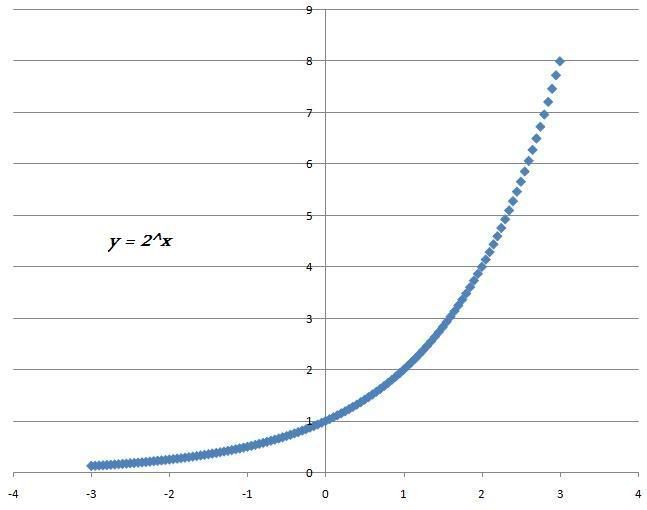
Thought, my fine friends, is where it's at.  I know that to the impatient investor it doesn't seem to generate much, but that's because we've believed the hype that everything is supposed to generate an immediate return on investment.  Sometimes, especially early on, ROI is almost imperceptible to the eye and harder still to measure but the benefits of thought should be viewed as lying on an exponential curve.  If you remember your high school algebra, an exponential curve starts off practically flat and runs close to the x-axis for a time.  Later though, a marvelous thing happens, the curve shoots up into the air, and if you have a really big sheet of graph paper, off into infinity. 

a typical exponential curve (courtesy Photobucket)
So spend a little time thinking, and if you're an organization looking to hire, hire a thinker or two.  You may find that your organization is better off as a consequence.  Doers do.  Thinkers, think and then do and when they do, hang on tight because the curve is about to take off.

Tuesday, June 22, 2010

Whitney, BP, Arlington. When will it stop?

It has been several weeks since last I wrote anything about BP or anything about anything for that matter.  Yet in the intervening span of time, not much has changed in Louisiana.  What has changed over the span, is that a new crisis, a new sign of poor management has arisen, this one at Arlington National Cemetery. Somehow, I see a connection between the oil spill of 2010 and the grave confusion at ANC.  To my mind, it's all about bad management, bad administration and the poor execution of professional responsibilities.  That's clearly something that's not the exclusive purview of federal government agencies.  Private and public organizations alike seem to suffer from that particular affliction.


There is an art to administration but where does one learn it? Business schools offer Bachelors', Masters' and Doctoral degrees in Business Administration but those degrees focus on Finance, Marketing, Organization Development, Human Resource Management and all manner of other thing.  What those degrees don't seem to focus on is Administration.  Those degrees don't focus on how to make stuff work efficiently and those degrees certainly don't focus on creating workplaces where the truth is spoken and incorporated into the daily activities of the workforce - truthtelling being a vital facet of adminstrative success. 


I realize that many of us like the lies we are told (and the ones we tell ourselves too), mostly because we would rather not have to deal with the truth.  Truth frequently makes us terribly uncomfortable and usually requires us to change something about ourselves.  Who wants to have to go there? 


Let's take as a case in point, the disastrous tour of Whitney Houston. Since she first appeared on Good Morning America more than a year ago, *singing* her hit song I Look to You, it was pretty clear to me that what we heard on the CD had been significantly manipulated to sound like the old Whitney.  I have no complaints about the work done in studio to beef up a weak voice, but having had to work so hard to produce something euphonious, perhaps someone should have told Whitney the truth and said, "No babe, you can't tour. Don't you think the rigors of touring might be too much for your voice?"  But instead, everyone went along and now, at venue after venue, at engagement after engagement, there are hundreds of dissatisfied fans.  Many of these fans may well cease being fans once this debacle is all over.  Why waste a comeback attempt, a CD that is well received, by doing a bad tour?  Is there no one in her camp willing to tell the truth?  Clearly not.


A good administrator it seems to me, recognizes that (s)he doesn't know everything that's going on in the organization.  How could he possibly?  Armed with this knowledge however, he seeks information from a variety of sources, making the effort to encourage a free flow of information across the organization - even negative information - so as to ensure that as many perspectives as possible are incorporated in decision-making processes.  And this is where Whitney, BP and now Arlington National Cemetery have something in common.  Clearly, the flow of information (especially negative information) is not free.  Clearly, Whitney's organization, like the BP organization, and now like the Arlington National Cemetery organization, have no tolerance for truth.  Indeed, with ANC we've already seen that the truthteller (aka whistleblower) was fired for 'stirring up foment' I guess, and then started blowing her whistle loudly once outside the gates.  While inside the organization, her concerns were not valued.  Indeed, so undervalued were her insights that she lost her job.


Until there is some broad movement towards teaching the rudiments of administration, this kind of thing will continue to happen.  All too often, companies are peopled by folk whose only goal is to climb the corporate ladder, good sense, good policy and good work be damned.  It's all about climbing, getting ahead, getting a bonus, getting a promotion, getting something.  Promotions are not frequently given to people who point out flaws in logic, flaws in policy, problems within organizations.  No.  What is saved for them is stagnation or termination.  Well I guess that works to save face but face saving inside the organization can result in gross embarassment outside the organization.  Ask Whitney.  Ask BP.  Ask the Arlington National Cemetery which now has lost hundreds of servicepeople's earthly remains and may spend the next decade trying to sort it out and regain any semblance of credibility.  But what do I know?  I'm looking for a job as a professional administrator and there just don't seem to be any takers.  I wonder why?

Sunday, May 9, 2010

A Hot Mess

That would be BP. Who would believe that they would still be throwing Hail Mary passes three weeks in?

Who can believe that they built this 100 ton or however many ton well cap, float it out to the site of their man-made catastrophe only to find that when they hoist and lower the doggone thing, crystals form inside it (in 5000 ft of water apparently these things happen, which you would think they would know), rendering it useless. And what, children, is the Plan B? They don't have one. Once again, they have no fall back position. Is this a comedy of errors or a tragicomedy? Frankly, I'm not laughing nor I imagine, are the people of the Gulf Coast.

I just want to say that if I were working there and I'd had my work fail so catastrophically, I'm thinking I would have been fired. Someone here is a complete misfit for their position (think Peter Principle) and yet, I suspect they remain employed. I just want to know: when is someone's head gonna roll, because this is past ridiculous? I'm telling you, this is criminal stupidity.

I don't begin to pretend that any of the solutions here are easy or obvious, but what is obvious is that not nearly enough questionining is occuring at BP. Clearly, there's no one asking the tough questions that need to be asked like: if this doesn't work, what's our backup plan? What about sea conditions? What do we do if the conditions at sea are inhospitable? What is the low tech solution to this problem? I mean, is there no one in this company with the cojones to challenge leadership's obviously flawed premises relating both to risk and to the prospects of any intervention actually succeeding? Isn't that what these folks get paid the big bucks for? Or do they just get paid to show up when stuff is working? If that's the case they should all just go home (cuz stuff ain't working) and let strangers off the street finish this up.