Showing posts with label business. Show all posts

Friday, December 9, 2016

Making a Way: Economics

Make a way out of no way
Over the next few years, we are going to have to do and be very different. The seasons have changed and we must make ready for winter.

I've seen one too many ridiculous memes about who and whose grandpappy made it through Jim Crow so we can too. While I understand the impetus to make such supposedly supportive utterances, I can't really say that they're helpful. I say if we want to be helpful to each other, we need to offer up some insights on what we might do to move ourselves forward economically, politically and socially.


If there is one thing that I am sure of, it is that the ingenuity and hard work that built the first Black Wall Street, can, and will, build us another if we make a concerted effort. This time around, with focus, effective use of social media and digital marketing tools, we can create and hopefully sustain an entire parallel universe.


1. Dreams matter


I've had various dreams over the last several years. One of those things involved abandoned houses in Detroit.  I recognize that my dream of rebuilding communities that have fallen on desperately hard times is a crazy one, especially since I'm neither a multi-millionaire nor am I especially handy with construction, but that doesn't make it any less of a great dream. I have visions of entirely self-sufficient communities, a central farm surrounded by homes, schools and every possible business needed by a community. Ain't nothing wrong with dreaming.

The next step after having the dream though, is taking action. What I probably should have done and I certainly encourage others to do, is find funding for your ideas and programs. There are grants. Go look. Network with non-profit professionals (if your dream is a non-profit) and find ways to make your dreams a reality. This isn't necessarily about becoming wealthy, although that would be lovely. It is about providing a needed service and making a way for yourself and those around you. 


Look into non-profits that received federal money to support entrepreneurs here. Start thinking about that thing that you think the world, your street or your community needs and begin the process of creating that. If a for profit enterprise is your thing, find incubator programs and reach out to the SBA and Score for support and guidance. 


I'm not for a minute saying, "Quit your day job!" but I am saying that we need to see what else we can do to build something with our sweat and ingenuity. 


2. Make a plan


I am under no illusions that this is going to be easy. Lord knows, 'easy' does not reside in our neighborhoods and even if it's just passing through, when it hears us coming, it runs like hell. We will have to work hard and fight tooth and nail for every inch of ground we can gain but how is that different from what obtains today?


Many in the urban centers, particularly in poorer neighborhoods, live in food deserts. Can you deliver healthful food in your neighborhood? Can you make 'real food' available? Can you and a few friends make something like this happen? Then do. There are communities aplenty in need of this kind of support. Do the research. Go to the neighborhood library. Get the help you need and try your hand.


Don't have money start a food desert supply service? Then what about creating an urban garden? Check out the guerilla gardener! Allow yourself to dream and be inspired to imagine some new thing that only you can do.


3. Use social media


Look, I'm no expert on social media. If I were, I might writing fake shite and laughing all the way to the bank. That's not me, that's not how I want to roll. Still, there are those of you who have your finger on the pulse of social media. Use it. You know how to drive traffic? Drive it in the general direction of up and coming Black and POC businesses, especially your own!


These are going to be trying times. Have you seen who's being tapped for Cabinet posts? Good Lordt! We better get our shite together! Use your vast social networks to create and sustain interest in your business and those of your friends.


4. Get the help you need

There are people out there who can help you. Everybody's got a computer in their pocket. Use it! Spend less time matching three cropsies or whatever and more time building yourself up for the days ahead. Trump and Bannon  are gonna be running the store for a minute. We'd better make sure we are ready for what that is likely to mean.

5. Support each other

We will need to rely on each other and we will need to support each other. One of the great things about the original Black Wall Street was that there were so many complementary businesses there, that a dollar circulated between 36 and 100 times before it left the community. Where do we do anything even close to that today? *Hint: nowhere

Do you have a friend who's a painter? Hire her/him to paint your house. Have a friend who's a caterer? Hire him/her to cater some part of your next shindig. Have a friend who's a writer (psst! lol)? Share their work. We are really going to have to do a new thing in this Brave New Trumpet World. Let me remind you that during the Montgomery Bus Boycott, thousands and thousands of Black men, women and children walked for months (13 to be exact, 381 days) to make themselves heard on the issue of desegregation. We need to 'make a point' (and to both ourselves and the majority) about self-determination. 


6. Network

Networking is critical to success in this society, it's also a significant part of why people of color do not thrive in the professional world the way others do. We don't create networks and we don't do the glad-handing and socializing that's required to maintain them. I understand it completely. So much of our lives in the professional world requires performance of Black acceptability that it gets wearying. We just want to go home and switch it off. I hear you. I feel you and I tell you "Not today". Stay plugged in and turned on. We can rest later; maybe four years out when Elizabeth Warren or Tulsi Gabbard is president-elect.  

There are Black Entrepreneurs Meetups and networking events. There are also Hispanic entrepreneurs meetups. Find a group that meets your needs or interest. Can't find one? Start one. Find a mentor. Become one. Join something that will uplift and encourage you. Get help and support. Ask questions. Be vulnerable. Be brave but don't immediately give up your day job!


I dream of the day when super wealthy POC's foundations create opportunities for fledgling micro-enterprises, but that may not soon come to pass. In the interim, we have to find other ways. Hopefully, one or two of the six ideas above will give us places to start. 

Ultimately, we must have faith....i
n ourselves and our circles and our circle's circles. We are going to have to have each others' backs. We are going to have to support each others' endeavors and network like our very lives depend on it because they just might. Prayer is good and all, but Jesus ain't buying your services, the people in your neighborhood are. So talk to Jesus, but talk to Jesús next door too.

We are going to have to imagine and work our way to independence. Whether we have a burning desire to be 'job creators' or we simply want to offer a good or service as a side hustle, we're going to have to hustle. A lot.


Whether ours is a brilliant massive idea or a simple small one, whatever our gift(s) are, use it (them). Seek out the help needed to make something out of nothing, a way out of no way, a bridge out of thin air. We don't have much choice.


When candidate Trump asked what we have to lose by voting for him, we had an inkling of what might be at stake. As time passes and his Cabinet starts to take shape though, the 'what' we might lose looks to be every damb thing. 


Trying times are ahead, be the change. 

And while we're out there doing our thing, join the Injustice Boycott because social justice activism and political action are just as critical as economic independence.  


Friday, January 7, 2011

Seeing and believing

Who hasn't been Ted Williams at some point in their life? Perhaps our moment of 'Ted-ness' didn't take us to the streets, but who among us hasn't drifted far off the path we envisaged for ourselves?  Who?

While we revel in the joy and excitement of Williams' new found hope and prospects, perhaps we should take a moment to consider that it is the fact of his having been seen that has given him this chance. Perhaps we should consider for a moment, that every day we pass folk on the streets (and in our homes?) who only want to be seen.


Seeing isn't nearly as hard as it might first appear.  It involves putting down the iPad, iPhone or other smartphone for a minute and making eye and emotional contact with the person right next to or in front of you.  Think about it.  Not too long ago, there were no gadgets to keep us as connected and yet disconnected from our neighbors.

Everywhere you go today, when you see someone down on their luck or just experiencing a rough patch, someone who is clearly in need of a hand, perhaps you might ask yourself, "Are you Ted Williams?" and follow that thought with whatever action you think is appropriate.  Maybe you'll buy someone a cup of coffee or put someone in touch with a coworker looking to fill a job.  Ted Williams isn't the only diamond out there waiting to be found and polished, given an opportunity to be set into a spectacular piece of jewelry.  No indeed, given our almost 10% unemployment,  you can rest assured that there are quite a few Teds out there.

Commit yourself to seeing and believing in someone today.  It's really not that hard.

Tuesday, January 4, 2011

Happy New Year!

At the end of every year, I consider how things have gone over the preceding twelve months. Over the last three or four years in particular, I've not wanted to peer too closely at things as things haven't progressed as well as I would have hoped. 2010, though was quite a departure. Perspective is a heckuva thing.

Though by many measures, I haven't done all that I would have liked, I was blessed to complete a project which, frankly, I've been wanting to complete for about 5 years.  Instead of being hampered by unemployment, I was freed by it.

People talk all the time about how being fired or downsized opens up new vistas, well, it's true for me as well.  As a consequence of the blessings of 2010, economic uncertainty notwithstanding, I see 2011 as an open year, brimming with new opportunities.  For once, I don't see the closure of a bad year but rather the opening of a great one, greater still than the one just ended. 

I'm very excited about 2011.  I hope you are too.  Happy New Year.

Monday, December 20, 2010

Free-Range Thinking

I'm fascinated by the hold that the notion of "thinking outside the box" has on business speak.  I wonder if anyone has taken a moment to consider what the converse of that might be. I would imagine that having considered the converse, TOTB would be considered de rigueur and we could, maybe, stop talking about it as though it were some great and wonderful thing instead of the most natural thing in the world.

What is a box? It's a container.  It is a thing limited in size and capacity.  But what is a thought? It's an idea or notion.  It may be transitory or permanent depending on the thinker's evaluation of the idea.  It is as wide or as narrow as the mind that thinks it.  It can be unlimited in size and capacity depending on how much energy its 'owner' gives it.  So here's my question: why in the world, would I squeeze that which is, by nature boundless into any container that is by its nature, bounded and therefore constricting?

Humans seem to like little sayings that embody general truths or perhaps it is tag lines that we like as they help us better understand the world.  TOTB has become a favorite tag line, a hot phrase that folks use when the limitedness of limited thinking is finally beginning to show in business and organizational performance. So here's my big idea: why not start with unbounded thinking? Why not start discouraging boxed thinking and start encouraging free-thinking, in all times and all places?  Why don't we all just start thinking freely and letting others do the same?

It occurs to me that the idea of thinking outside the box is at its core, about empowerment.  Empowered folk naturally think outside the box because they're free.  They are free to do and be whomever it is they are.  Boxed folk, on the other hand, have to be encouraged to think freely.  So here's my advice: get a box cutter, cut the box to shreds and then just think. And don't be afraid to share the thought.  Waste little time dissecting the thought down to nothing.  Just think.  It's quite liberating.

If free-range chicken is good, can you even imagine how good free-range thinking might be?  Try it some time. That's what I'm going to be doing (more of) for the New Year: Free-range thinking. Now go on and open up that box.

Tuesday, December 14, 2010

Allergy Season


I have allergies.  There are trees and grasses to which I'm allergic and a few foods as well, most notably crab, which is especially unfortunate.  More than food and flora though, I'm allergic to fast meaningless talk.  Fast talk and fast talkers,  bring on the vapid empty smile and the loud self-talk that keeps me from saying out loud, "For goodness sake, what are you really trying to say?"

The other day, someone reached out to me on a professional social networking site.  This individual started her interaction by referring to me as an A+ professional (what is that exactly?) and going on to say that she was looking to build a team of A+ professionals for a business with which she works.  OK.  So far so good.

Being (i) polite and (ii) mildly interested in the opportunity she was selling, I responded asking for further information. What I got in return was a lot of words, words full of sound and fury, as Shakespeare would say, but signifying nothing.   It took me a couple of reads but I really couldn't figure out what the angle of this *business* was.  Her email was either deliberately vague or just unfortunately obtuse.  Either way, a very bad sign. At any rate, I didn't have sufficient information to make the decision to take time away from the things I must do, to go and find out more about something I might do.  I said, "No thank you".  I assumed that was the end of that.  Wrong!

Consider my horror then, when she writes me back this mildly insulting note in which she asserts that "We can not promise anyone anything who are not at least willing to meet our team, for we can afford to be very selected [I think she meant 'selective'] as to whomever we want to bring aboard."  She went on to say that "[t]he information and mechanics to our firm can be given out at anytime [so why then would you not give me proper information when I asked for it?] and most preferred, through the interview process.  We feel that if the candidate is not willing to meet our team [did I indicate unwillingness or did I simply request more complete information?], and/or does not interact well with our team, then, there is no need to waste time giving out our information to the wrong candidate." Well, let me not "waste your time" then.

I'm so fascinated by people who, when they don't get what they want, can find no other response than to denigrate that which they cannot have. What's that about?  Don't I get a choice?  And having made a choice, what right have you to insult me for choosing other than you? I mean come on, can we try to be adults? Please? Just for a minute maybe?  This all reminds me of a guy I met some time ago.  Things were proceeding rather slowly and laboriously, so I suggested that we weren't a good match.  His response, "That's right cause you are one boring a@# b*tch!" (clearly he hasn't read my blog!).  Because I like to poke wild animals, I responded, "Clearly I was right in my assessment.  No man I would date would speak to a woman that way."  I think I wished him the peace of God after that. 

Never let it be said that I don't give as good as I get. This time though, I'll leave well enough alone.  Sometimes wild animals can be unpredictable and given that we share the same social space, professionally speaking, I would probably be advised to slink quietly away and give her no reason to slash and burn my professional reputation.  *slink, slink* [the sound of me slinking away]

Friday, October 29, 2010

Ethics vs Innovation. Competing commitments?

What a strange story!  I recently read on a blog an article about the tension between innovation and ethics and all I could think after reading it was that clearly I had missed something.  The author referred to an article she had read elsewhere that had caused her to make the intellectual leap that perhaps there was a tension between the two - innovation and ethics.  The trigger article is: If You Think It's Unethical It Probably Is,  written by Eileen Zimmerman which appeared in the NY Times on October 23, 2010.  You should give it a look. It's quite interesting.

Now that I've read Ms. Zimmerman's article though, I think I really must have missed something and I have to say that I don't quite understand where this tension between innovative thinking and ethics became an issue.  Ms. Zimmerman's article spends a lot of time talking about how to push back (without killing your career), if you think something you've been asked to do, crosses ethical lines.  Never does she suggest that there is a tension, nor indeed does she ever refer to innovation either covertly or explicitly in her writing.

To innovate (per dictionary.reference.com), is to "introduce something new; make changes in anything established".  Implicit in that definition is an understanding that that which is created is rooted in truth.  Perhaps that isn't implicit to anyone but me, but I fail to see how lying could be considered innovative, unless we are talking about taking an innovative approach to the facts.  An old choir director of mine used to joke about people who didn't know the music but would sing their own 'impressionistic renderings' of the songs.  That's innovation too I guess except it was greatly discouraged in the choir, as it should be in business.  Harmony easily becomes cacophony when people play fast and loose with the truth be that musical truth (the notes) or business truth (the numbers).

I am a big believer that innovation is the only way for an organization to stay relevant but I question whether anything that involves lying or otherwise misrepresenting the true facts of business performance could even be loosely categorized as 'innovation'.  I am also not sure that even on the keenest cutting edge of innovation it is necessary to compromise one’s ethics. I am certain that there are areas of scientific endeavor where the ‘edge’ goes beyond anything I can imagine, but where innovation challenges prevailing ethical constraints, processes usually exist to challenge those ethical lines.  Think back to the first IVF and the ethical debates that raged then.  Think now about stem cell research and the raging ethical debates in that field.  Innovation is all about challenging the status quo, but for those wishing to do so ethically, there are ways to challenge without stepping all over moral and/or legal boundaries.

In most businesses, it seems to me, where ethical lines are crossed it is not because of some wonderful, business-saving innovation that runs afoul of prevailing ethical norms (creating some mythical tension), but rather it is usually because of a blind and dangerous (just ask Wall Street) focus on a profit motive.

Once business people take their eyes off ethics and focus wholly and solely on profit margins, P/E ratios and market capitalization, trouble surely follows.  Innovation is not the enemy of ethics, greed is.  The tension really is between money and ethics.  Don't blame innovation.  She wasn't even there when the bacchanal began.

Thursday, October 28, 2010

Chaos and Calm

So I was reading this article some weeks ago in which the author posited that leaders need to be both 'clarity agents' and 'chaos double agents'.  I heard what the author was saying, but I really didn't quite agree.  Basically the author was saying that good leaders should create both clarity and chaos in their organizations as circumstances merit.  According to Mr. Dunbar the author of the article Clarity Agents and Chaos Double Agents, when we live in an environment of "volatility, uncertainty, complexity and ambiguity" (VUCA as he calls it), we need our leaders to create chaos when there is too much calm.

My problem with this notion isn't the philosophy of it, so much as it is the language of it.  It's great marketing/branding to have this almost alliterative title, but I reject the idea of 'chaos'.  Words have power and alliteration aside, another word (one with a less pejorative connotation), might just make for a deeper understanding of what the author is trying to convey.

Here's what my favorite online dictionary says about the word 'chaos'.
  1. state of utter confusion or disorder; a total lack of organization or order
  2. any confused, disorderly mass: a chaos of meaningless phrases 
  3. the infinity of space or formless matter supposed to have preceded the existence of the ordered universe.
offered for 'chaos' include: disarray, jumble, turmoil.  Related words include such lovely choices as bedlam, pandemonium. Who really wants to be associated with 'pandemonium' or the creation thereof?

To suggest that a leader deliberately create this thing called 'chaos' in her organization, implies that there is no other way to avoid becoming mired in a comfortable status quo.  According to Dunbar, "the enemy of improvement in performance and enabling the ability to innovate is being comfortable and allowing the status quo to maintain. In the future, successful organizations will be defined by leaders that are disruptive and creative."  While he will get no argument from me on the underlying premise of his thought, it is the use of those last two words together that makes me nervous.  Disruptive and creative?  Therein lies the very pejorative connotation I'm talking about.


I don't think it's playing semantic games to say that to use the word 'chaos' is to lend further credence to the notion that those who would seek to challenge the status quo (that's a better 'c' word right there), are necessarily being 'disruptive' (per dictionary.com = causing trouble, confusion).  The problem with this thinking is that it automatically presumes the transcendence of the existing state and subtly suggests that any challenges to same are necessarily mischievous in their intent.  Isn't there sufficient evidence abroad that status quos need to be challenged?  Moreover, the idea of leader as challenger of settled states also subtly reinforces the age old idea, that only leaders may challenge.  Other sources of challenge, from persons not granted fiat to do so, can be viewed as 'disruptions'.  That's the kind of thinking that entrenches stable states and leads to the eventual demise of previously thriving businesses.

In my response to the author, I wrote that the status quo is to be feared and that organizations and their leaders would do well to entertain ideas from everywhere and anywhere - both within and without their organizations.  Yes, it would be wonderful to have a leader who saw the stable state as problematic, but that isn't always the case.  Further, sometimes it is the leader him/herself, who is least interested in changing the way things are done.  Rather than look to the leader for challenge, an organization needs to create an environment where everyone from top to bottom, is seeking improvement all the time and feels comfortable offering a different perspective.  When the only lens through which different perspectives is viewed is the lens of 'creating chaos', you can be pretty sure there won't be much chaos created.


Words harm, words restrict and ultimately, words can kill action....and organizations.

Friday, September 10, 2010

Doing more with less my hindparts

Who is the idiot that first coined this phrase? It is the most asinine piece of nonsense I have ever heard.

How do you do MORE with LESS?  I'd really like someone to tell me.  Here's what I propose: instead of talking nonsense about doing more with less, why don't we try to figure out how to fill as many competing needs as we can, to some satisfactory degree with whatever the 'less' is.  We can't do more with less, so we really need to stop saying it as though it makes sense.  It doesn't.

My suggestion is that we try to balance the competing interests by holding on to the critical things and sacrificing others.  As a musician this pains me because I know that when it comes to schools, 'sacrifice' usually means kicking music to the curb, but volunteers can do as great a job teaching music as paid teachers can.

'Doing more with less' should mean looking for creative ways of filling old needs, ways that don't require large outlays of cash.  That's more with less.  Sometimes doing more means asking more of participants and less means less free stuff, more self pay or co-pay.  In cases of financial hardship which currently abound, it will mean finding ways to help each other along without making anyone ashamed of their difficult circumstances.

Look I don't have answers here.  All I know is that we really need to run as fast as we can from the notion that we can possibly do more with less.  It's such a stupid saying, I can't believe it has so caught on.  Can you feed a family of 5 with the food supplies needed to feed a single person?  Certainly you can, but no one is satisfied nor is anyone appropriately nourished.  Perhaps we should try to focus on ensuring that there's satisfaction and nourishment, even if it means it's a no-frills meal.  It's a meal.  Needs are met and that's the whole point.

There's a way to make do in tough times that doesn't sacrifice quality, but saying, "Let's get out there and do more with less" isn't it.  This stupid one liner doesn't acknowledge the efforts of administrators large and small, who struggle to keep their programs running on fumes and faith.  What this sentence is, in a nutshell, is an insult to the intelligence of the listener and the effort of the administrator and frankly, it's an excuse to bully and harass staff into working like Hebrew slaves, but don't let me get started on that.

Thursday, September 9, 2010

The American Dream

The other day, I was reading an article in the Washington Post, written by the President and CEO of ING Direct - Arkadi Kuhlmann, Friday 3 September - in which he was positing that the American Dream was undermining America.  His basic premise (if I understood him correctly), was that 30 year mortgages are an old fashioned tool for home ownership in a world of advanced financial tools. He further contended that homeowners, should be encouraged (through an eventual elimination of the tax credit for interest and its replacement with a credit for payments to principal) not only to take shorter term mortgages, but also to make efforts to pay down the principal balance on their loans.  Interesting.

To some extent, this makes good sense to me, but I wonder though about obvious requirement to manage one's credit that his recommendation would necessitate.  The core premise of his proposal is that 30 year loans should become much shorter loans, perhaps even as short as 5 years.  He writes, "[o]n a typical $225,000 mortgage, a buyer who gets a five-year, fixed-rate mortgage at 3.50 percent might well pay 4.75 percent for a 30-year loan. The savings would come to more than $11,000 when it's time to refinance the five-year agreement."  While an owner might certainly appreciate the $11,000 in savings, is the s/he willing to pay the price of that 11K?  Because it ain't about to be free.  S/he is going to have to monitor and manage their credit like they're trying to buy their first home.  And they're going to have to be diligent about that credit score, pretty much FOR LIFE under this model.  So the issue then becomes, what happens at year number five if the buyer's credit score is too low to qualify for a refinance on favorable terms?  What if, Heaven forbid, we're in a recession such as we are in now, where almost 10% of the population is unemployed?  What happens then?  Does the 5 year loan simply renew at existing rates (using the qualifying credit score perhaps?) or or does the buyer, now with poor credit, have to renegotiate the loan at whatever rates the banks are offering at the time? Suddenly, that $11,000 savings isn't looking nearly as attractive.

As good an idea as this might seem, it requires of consumers an approach to managing money that doesn't currently exist in this society: FRUGALITY.  That word doesn't have a much of a home in the American lexicon, nor indeed, does it even fit with the way the economic engine of the society works.  The engine of the American economy is the American consumer.  To rewrite that equation would require such significant change to the American psyche that frankly, I can't see it happening.  Perhaps, if this current recession were prolonged (Heaven forbid!) and people were to learn the value of saving over spending; perhaps if, during this dreadful period, people came to understand that a credit card is not a financial buffer, perhaps then it might be possible to inch gingerly in this direction.  But I'm not feeling that happening. 

Mr. Kuhlmann's idea may have great merit, but it fails to take in to consideration the sociology of the society involved.  A new model for financing is a great thing, but it must be based on the context into which it is to be applied.  The context here: spend, spend, spend; go out after 9/11 and spend; we're at war so spend; we're in a recession, I'll send you a check for you to spend; is diametrically opposed to the model Mr. Kuhlmann recommends. 

The reality is that the American consumer spends so much time consuming and being encouraged to consume, that the idea of having to perennially manage the credit score may well be inimical to national best interests.  This is not my personal feeling but when I listen to the talking heads blather on about restarting the economy, what I hear is much talk about consumer confidence - i.e.: consumer willingness to shop.  It's not about the innovation or creativity; it's about shopping.  If this new model of home-ownership were to take root, it would seem to me that it would either, (i) put a serious dent in consumer spending as we would all be more focused on managing our use of credit not simply for the first purchase of the house but through the life of the loan; or (ii) there would ultimately be far more bankruptcies and foreclosures, as people unwilling/unable to manage their spending would find themselves in a nasty bind 5 years out, much as has happened over the last 2 to 3 years.

The unstated premise of Mr. Kuhlmann's idea is that Americans need a radical reframing of how they use their disposable income.  We need to 'dispose' of far less and much more 'retain' far more of it.  Even now, as the economy struggles to regain its footing, the idea that people are choosing to pay down debt and save is already making economists sweat.  I can't begin to imagine what would happen if a movement towards frugality and fiscal responsibility were to take hold more generally.  Fortunately, or unfortunately, I don't really see that happening any time soon...the iPhone5 is bound to be a must have, as is the next gen iPad and the next gen iPod.  In truth there's always a must have 'next gen' something just waiting to catch me at a moment of weakness.

Here's a link to the Washington Post article:  Rebuild the Path to American Homeownership

Wednesday, August 11, 2010

My dear Mr. Slater

I'm wondering about Mr. Slater's rant on a recent Jet Blue flight, but more than that, I'm wondering about the nation's response to it.  I'm not sure which is more telling, the initial transactions (the head bump by the passenger or the response to said bump), or the cultlike following Mr. Slater has attracted.  I'm wondering: are we all so miserable at work that someone else's mad rant and storming out of the 'office' is cause for applause?  I'm just wondering.

Did Mr. Slater have a real grievance?  Absolutely.  The passenger was ill-mannered and should have at least offered an apology for bumping Mr. Slater in the head with her bag.  Of course, she offered no apology (because service people are not entitled to basic respect, but that's an issue for another day) and so Mr. Slater probably worn down by one too many ill-mannered passengers, blew a gasket.

So here's my big question: what is it that is happening in organizations that is causing employees to be simmering pots of rage?  It seems to me that the only reason this thing could have resonated so deeply with the populace, is that people are unable to speak their piece in peace in their work environments.  More than that I think that people are being bullied and harassed in awful ways at work and consequently, they are longing for a hero, someone who says one day, "Enough with this crap! I'm done!", enter Mr. Slater with his Facebook fan page with one hundred thousand plus fans. 

If I were an HR practitioner, I'd be looking at the events of the last couple of days and asking myself whether there was something bubbling under the surface at my organization as well.  I'd be asking myself whether my company had any staff who, given the challenging economic times coupled with the stresses of family life, might be on the verge of an explosion of their own. I'd be asking the question and talking to other HR people in the organization to get a sense of whether anyone else felt this was something we needed to be acting on.

My feeling is that Jet Blue was lucky.  Mr. Slater only cursed out a passenger and deployed a safety device unnecessarily.  Other employees under the same pressures might express their distress in ways that could endanger lives.  I'm just saying.

The wave of approval for Mr. Slater's actions is very telling.  Is anyone listening to the story the response is telling us?  I sure hope so.

Tuesday, August 10, 2010

Exponential curves

I had the pleasure of attending a meeting of other between opportunities 40+ year olds recently.  What fascinated me was the moment in the presentation when "HR departments" and "HR people" were briefly discussed.  Clearly, the vibe I've been getting about recruitment is one that may well be shared more broadly.

The speaker, a woman with 30+ years' experience in Strategic Communications and Marketing was speaking on creating a Marketing plan for one's job search.  During the course of her discussion, she mentioned in passing that even now (30 years after graduating from university), she is sometimes asked about the relevance of her History undergraduate degree and her graduate work (also in History), to her career choice.  I ask you, at what point does the degree cease to matter?  After 30 years doing the work successfully, and rising to the position of VP of Marketing and Public Relations, isn't the degree a moot point?

This raises a question in my mind about the quality of interviewing that's taking place.  I sometimes wonder  whether organizations recognize that a candidate who has a breadth of knowledge in areas outside the specific narrow focus of the company is actually a great find.  All that 'other' knowledge is available to be brought to bear on current problems/challenges within your organization.  All that 'other' knowledge opens up an entirely different way of looking at and solving problems.  Who wouldn't want that?  It seems to me that the challenges organizations and countries face, well from that fact that there isn't enough THINKING going on and when I say 'thinking' I don't mean identical thinking, I mean different thinking, outside-the-norm thinking.  DOING has trumped THINKING and I'm here to plead (a small voice crying out in the wilderness) for thought.

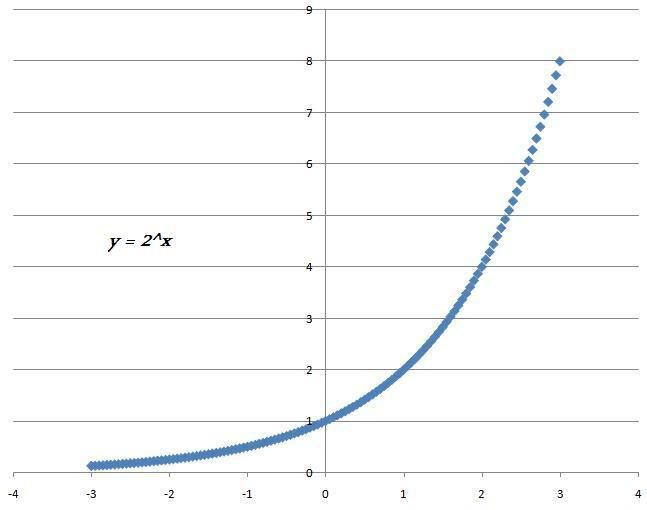
Thought, my fine friends, is where it's at.  I know that to the impatient investor it doesn't seem to generate much, but that's because we've believed the hype that everything is supposed to generate an immediate return on investment.  Sometimes, especially early on, ROI is almost imperceptible to the eye and harder still to measure but the benefits of thought should be viewed as lying on an exponential curve.  If you remember your high school algebra, an exponential curve starts off practically flat and runs close to the x-axis for a time.  Later though, a marvelous thing happens, the curve shoots up into the air, and if you have a really big sheet of graph paper, off into infinity. 

a typical exponential curve (courtesy Photobucket)
So spend a little time thinking, and if you're an organization looking to hire, hire a thinker or two.  You may find that your organization is better off as a consequence.  Doers do.  Thinkers, think and then do and when they do, hang on tight because the curve is about to take off.

Friday, August 6, 2010

First come, first served? Bad idea.

Several years ago, I was invited to be a member of a team for a competition.  I agreed to participate but there were issues, primary among them, a complete lack of external ownership or leadership of the team.  In the absence of external leadership, we tried to establish some internal direction of our own.  Unfortunately, one member of the team (the person who had been called first and presumably saw himself as the leader) flatly refused participate in any preparatory work with the rest of us. We tried several times to encourage him to join us in prep meetings, but he was always too busy.  

The young gentleman never met with us.  When the rest of the team met, we determined that he couldn't be part of the A team.  Given that he had never met with us and got a sense of how we worked, we felt it in the best interests of the team that he serve in a minor role.  Once we got to the competition venue, we tried to tell him this gently but he didn't take it well.  We made the tactical error of delivering this information in a public place (a very bad idea) and he had a royal meltdown.  The wine he had had at dinner probably didn't help his reaction, but let's just say that the way he carried on was quite embarrassing.  He was so pissed, he changed his flight arrangments and returned home the next morning.  Apparently, if he wasn't to be on the A team, he wouldn't play at all. 

Now, this is where the story got interesting because he ran home and reported us.  I have no idea what details he might have reported, but when we got back, we were called in to be upbraided.  The Director advised me that she was extremely disturbed at our treatment of him.  I, being genetically opposed to being upbraided unfairly (an ailment from which I am slowly recovering), asked her whether in his reporting he had advised her of our repeated attempts to have him join us to prepare (and his repeated refusals).  Pause, "Uh, no."  I asked whether he had, in his reportings, advised her of his behavior in the public space of the hotel, when we tried to explain why he would need to serve as alternate as a consequence of his refusal to prepare jointly.  "Uh, no." she replied.  So he had shared only the version of the story that made him look like the wronged party and she, instead of getting the other side, had leapt to a conclusion and doled out punishment without first doing any independent research.

What I learned that day was simply this: first come, first served; first spoke is first believed.  Moreover, having spoken first, you must have been telling the truth.  Why would you hustle to report a lie?  In fact though, it is the liars who have the most to gain by reporting first and inferring truth from eagerness to report is a most unwise approach to management.  The job of management is to troubleshoot interpersonal conflicts that affect team dynamics.  Instead of doing that, what I've found (and this has happened to me more than once now), is that rather than troubleshoot, managers sometimes just take the path of least resistance. 

'First spoke, first believed' is rubbish.  It's a lazy way of dealing with the inevitable conflicts and challenges that will arise on any team.  To presume that the first to speak is telling the truth is to forget human nature.  Children who tell tales usually do so in an effort to protect themselves from the consequences of their own malfeasance.  We should assume that the same is true of adult employees who have not only face to save, but jobs and lifestyles to preserve.  Managers would also do well to consider that he/she who does not report, may have much to report as well, but (s)he chooses to handle conflict by using his/her words, not by running to the teacher. 

Wednesday, July 7, 2010

In Praise of Administration

Back when I was in high school, before the turn of the century, there was a class being taught which frankly never interested me much.  The class was titled "Office Procedures".  This class was one that was primarily offered to students who were not, shall we say, academically gifted.  It was usually the girls (I went to an all girls high school in Trinidad & Tobago) who wouldn't be successful at Physics or Chemistry, Biology or Technical Drawing who were guided into Office Procedures.  Hah.  Would that we had known then what we know now, everybody would have had to do that class and everybody would still be doing it today.


Over the last several weeks, I think we've all seen the negative effects of bad administration.  We see it in the management of the claims processes in the Gulf region, we see it in the spill in the Gulf, we see it in the mess at Arlington National Cemetery and this morning, we saw it in the Enterprise Rent-A-Car catastrophe in which two young women died because the car they rented had been recalled but not pulled out of circulation by Enterprise.  Closer to home, I have seen it in the six phone calls I've had to make to one doctor's office to get a single letter.  I still haven't got the letter.


I've had cause to say this before but I'll say it again, administration is not some throw away aspect of an organization's activities.  If it were, they wouldn't bother to do it at all.  It is critical to the efficiency of an organization that the right people, with the right skills and the right personal attributes be placed in positions of administrative leadership.  Why organizations treat these positions as ancillary I don't know, but in truth, they are anything but.


An assistant who fails to make appropriate flight arrangements for her boss leaving said boss on the ground while a critical meeting takes place is of no use as a travel planner.  An assistant who fails to see that reports needing to be generated will require paper for printing said reports; binders into which documents must be placed and tabs to separate sections, and fails also to recognize that the appropriate order for supplies must be placed in a timely manner, isn't much help in supporting his/her manager whose responsibility it is to report on company performance.  Certainly, administrative staff can learn these things, but wouldn't it be better if we all got to the office knowing how to think these things through?


When is the world going to realize that the cost of high school dropouts is not just a cost to the dropout, but also a cost to those of us who stayed in!  Since the boss can't do it all, she has to rely on support staff.  If her support staff is ill-equipped to support, what happens then, 'Ole mas' as we say in Trinidad.  Loosely translated: all hell breaks loose.  So go on a quit if you want to, but just bear in mind that you're not the only one who's going to have to pay the price.  You will pay, your family will pay, your community will pay and ultimately, your country will pay.  Concerned about national debt?  Say your behind in school and do something about it.

Sunday, June 27, 2010

Whiplash - of the Philosophical Kind

In its response to crises, the Obama Administration generally focuses at the top of the tree.  The President identifies someone of like mind whom he trusts and asks that individual to establish the overarching framework for the reformulation of a particular industry.  The individual then becomes known as his (the President's) Czar for this, that or the other thing.  He’s done this now with the auto industry, identifying an Auto Czar Ed Montgomery; he’s done it with Afghanistan & Pakistan, TARP and cyber security to name a few.  There are other positions that he inherited - Czars for AIDS, Foreign Aid, Poverty, Energy, Drugs.  The list is fairly comprehensive.  What is troubling to me though is that while great attention is being paid to the top of the tree, far less seems to be being focused on the root system which sustains these trees.

We often sneer at the use of the words ‘bureaucracy’ and ‘bureaucrat’ but the fact of the matter is that it is bureaucracy that is the indispensable executing arm of this or any Administration.  To focus too closely on the leader of a particular system (tree top) and not focus at all on the sustaining system is, I think, a recipe for disaster.  Administrations establish philosophy and direction, but it is bureaucrats (aka federal government employees) who execute the established policies.  When they do so poorly, or not at all, chaos ensues.  

Take for instance, the horrible mess that is the Minerals Management Service – MMS. The approach to regulation and oversight during the Bush years was born of the Bush Administration’s attitude to same: less is good, none is better.  The agency inherited by the Obama Administration therefore, was functioning according to an approach to regulation that was on the opposite end of the spectrum from what the incoming Administration wanted.  That being the case, an immediate ‘intervention’ and culture change operation ought to have been mounted. That should have been the first order of business.  In hindsight of course, anyone with an ounce of organizational savvy can see this, but for some reason the effect of culture on execution of policy seems to have been overlooked in the heady days between the election and the current crisis.  Why is that?  That’s a question that’s not getting a lot of airtime, but probably should (for many reasons not the least of which is that I don’t think that MMS is the only Agency likely to be having this kind of philosophical whiplash).  

The mistake here wasn’t that housecleaning wasn’t done (witch hunting in the workplace is still illegal, ask former Attorney General Alberto Gonzalez), but rather that no one seems to have taken the time to establish what the new rules of engagement were or to make clear that non-adherence to same would bring severe consequences.  If new rules were in fact outlined but were not followed, the failure of internal review mechanisms needs to be investigated as well, not with a view to firing anyone but with a view to identifying where the breakdowns in the system occurred and ensuring that they don’t occur again.   


Firing folk after the fact is a Pyrrhic victory.  We all may feel a little better once they’ve gone, but it solves nothing in the long run.  Moreover, a firing, much like a public execution, is really only a pretense that something has been done.  It’s the private organizational work that matters, not the public humiliation of a single person…even if the person really did need to go.

Tuesday, June 22, 2010

He did WHAT?

I'm trying to drum up some distress over the President's two hour vacation playing a round of golf on Father's Day.  So far, no luck.  I appreciate that others are getting their nickers in a twist, but really I can't imagine that President Obama taking two hours off has really set the course of American history back significantly.  I'm having much more success though getting pissed over General McChrystal's deeply ill-advised series of interviews with Rolling Stone magazine.  Good on ya, General.  Real classy.

When I read of the good general's complaints about the President, I say two things: first, he is entirely entitled to his opinions and second, he is free to express them.  I have no trouble with either his feelings or his expression of same.  I trust that if he gets fired, he won't complain that the President overreacted though because the President is as entitled to his opinion (negative from all reports) and his reaction (a firing I hope) as is the general.

We all want to be heard, as well we should, but with that freedom comes the uncertainty over how what we say will be received.  I'm almost hoping that the President sends the good general packing.  I appreciate that there is a need for continuity in the war effort, but this level of disrespect cannot go unacknowledged.  There is an alarming level of disrespect for this President (I won't suggest that it's because he's black but there are some who would) and it's really got to stop.  We have grown men in the house shouting that the President is a liar (and raising copious amounts of money in the immediate afternmath); you have the highest number of threats agains the person of the President in history; you have people refusing to meet the President when he comes to their state and now, you have the leader of the war effort making dismissive and disrespectful remarks not only about the President but also about the Vice-President and the National Security Adviser.  My question: are all of these people a problem really or are they a problem because they disagree with McChrystal?  Whatever the reasoning behind this most unfortunate event, McChrystal is so far wrong that I'm hopeful that he will tender his abject apologies and his resignation.  General, please close the door behind you as you depart, because it is most assuredly time for you to depart.

Monday, May 3, 2010

EPIC

Explain to me, if you can, how a big a#%$ company like BP can determine that it is cheaper to gamble with the environment than to pay the few million or many million for the safety valve that shuts off a well if something goes wrong?

Of course I know there's no explanation necessary. Companies like BP have two things going for them. First, they have friends in high places. Would that I had a few such myself, I wouldn't be out here writing my genius on a blog that only I read. Second, having important friends, they can put profits ahead of, well, everything. Decency was never a big value for companies, and clearly, as far as poster children for indecent corporate behavior, BP wins the prize. The people of the Gulf Coast however, get the Zonk (to use Let's Make a Deal terminology).

It became clear to me, within the first couple of days of cleanup and well-plugging activities, that BP had not done a proper scenario planning activity in advance of a catastrophe. Clearly, they had not considered what would happen if everything went wrong. I realize that such planning is extreme, but given the nature of the work they do - drilling for oil in water 5000 feet deep - and the risks of accidents to the environment, what justification could they possibly name for avoiding such a review?

I pray that they will eventually get the spill under control, but in the interim, what really needs to occur is that someone at BP needs to resign, be fired or better, be sent to the Gulf to work at cleaning up the mess his decisions have caused. This is a risk management failure of epic proportions. E-P-I-C. The VP Operations, or the senior-most risk manager needs to move to the Gulf Coast and work cleanup on the beach for the next 5 years or perhaps even the balance of his career.

This level of failure is almost criminal if not actually criminal. Mark my words, down the road, we're going to hear that the number crunchers did a cost/benefit analysis on the cost of additional safety procedures and that they determined that those procedures weren't worth it. Why, you ask? The decision was made, we will hear, because the probability of catastrophic failure, rig loss, oil spill AND inhospitable weather conditions was so low that there was no real 'benefit' to absorbing the costs of the additional safety procedures/techonologies. Yeah, well we see how well that's worked out.


Isn't it time we stopped seeing safety as an addendum to any plan and more the centerpiece? Whatever happened to "Safety First"? Or doesn't 'safety' include the safety of the environment?

Friday, April 30, 2010

Go Ford!

I just have to say that the Ford Motor Company is making me very happy.

Some time in 2008, I said to someone that if I had the wherewithal to do it, I would be Ford shares. Unfortunately, I really didn't have the funds so I couldn't buy. At the time, I was also saying that I needed to decide whether the buy a Ford motorcar or Ford shares. I decided on the shares because I really felt that of all the American auto companies, Ford was the one to watch. I was right. Look at what Ford has been able to accomplish in 1 year!

The $4 billion earned in the past two quarters is a testament to the value of real leadership in the boardroom. Even before the rest of the auto world seemed to be aware of the challenges ahead, Ford was mortgaging everything to access the cash needed to reinvent itself. That is leadership. I'm sure that at the time, there were analysts who, not knowing or seeing what the Ford leadership was seeing or knew, thought that Ford CEO Alan Mulally was out of his mind. Why would you take on $20+ billion in debt when there was no obvious crisis at hand? Well, the answer to that question is: so that when opportunity knocks, you can open your doors and welcome it in.

And so here we are. Over the last 9 months or so, consumers have been taking a long hard look at Ford and thinking that maybe, just maybe, this company knows what it's doing. The buying public's loss of confidence in Toyota coming at the same time as reports of increasing reliability of the Ford products have proved to be a magic elixir for Ford. That was opportunity knocking and Ford was ready to open the door.

It is very easy, as the new leader in an organization, to go with the status quo. To some extent, it may actually be necessary. Some time needs to be spent observing how business is done, before any significant changes are made. Add to that, a new CEO is entirely dependent on the information provided to him/her by direct reports seeking to establish themselves in the new pecking order. All the internal politics and poli-tricks aside, CEO Mulally chose this path. And a good thing too!

As a stranger to the auto world, Mulally came to Ford from Boeing, the new CEO had the advantage of clear sight uncluttered by old mores and protocols. That he trusted his insights and experience is a testament to his skill as a manager and leader. One of the things that often holds us back is the inability to see things in a new way. In the case of Mulally, he had never been in the industry before, so he could only see what his instincts as a businessman would allow him to see. He wasn't blinded by the 'this is the way we do business' line of reasoning. As it turns out, what he saw as an outsider allowed him to come to DC in the summer of 2009 and not take a penny from the Federal Government. Lucky him. Lucky Ford, because Chrysler and GM have faced a fair amount of hostility as a consequence of their borrowings. Opportunity. Knocking. Again.

At the end of the day, it's all about the quality of the product and Ford's got that. At the end of the day, it's all about organizational leadership and Ford's definitely got that. Would that every company had the benefit of visionary leadership.

Wednesday, March 3, 2010

Voices in the cockpit

First it was children in the air traffic control center, then yesterday, I heard about CAPT Holly Graf, the Navy Commander who had to be relieved of her command for creating a hostile work environment aboard her ship. As different as the two events are, I see a theme. Well, I'm always looking for 'themes' and connections, perhaps that's why I see them. To my mind what's going on here isn't just bad judgment or bad behavior, it's bad behavior in environments where bad behavior has traditionally been ignored or justified, so bad behavior goes from mildly bad to egregious, over a period of time.

Investigations are just beginning in the case of the 'Baby on the phone' case at New York's JFK airport, but the report is already out on CAPT Graf and it isn't good. It says in part, that "[T]he evidence shows" that Graf violated Navy regulations "by demeaning, humiliating, publicly belittling and verbally assaulting ... subordinates while in command of Cowpens". It goes on to say that "[h]er actions exceeded the firm methods needed to succeed or even thrive and [that] her harsh language and profanity were rarely followed with any instruction." (follow link below for full report on TIME.com) Interesting.

Sometimes I really have to wonder who's minding the store. Who is the authority or standard bearer for management behavior, because some of the things that happen are clearly happening under the 'watchful' eye of a blind leader. In the case of CAPT Graf, was the good CAPT even being managed? I certainly appreciate that the Navy is not a commercial business and so different rules apply, but terrorizing staff - whether they be sailors or salesmen - has, I think, been conclusively proven to have negative rather than positive effects on morale and productivity. It would seem to me that if ever there was an organization where we would want morale to be high, it would be the Armed Services....but I could be wrong. Why would one want there to be high morale in the Armed Services? We're only asking them to go out and put their lives on the line. I suppose you could do that while not trusting the people around you or your commander, but I don't know that we would particularly like the outcome if soldiers and sailors went to 'work' with a mindset of "I'll just have to take care of myself since I can't trust these people to have my back".

When it comes to the children in the Air Traffic Control center at JFK, one of the busiest airports in the US if not the world, I have to ask what the decision-makers were thinking. Were they thinking? And if there was some thought process, could you please let us know what it was? Instead of just firing the father and the supervisor, which should occur post haste, I would want to hear what was going on in their heads as they made the choices that brought us these events. My guess is that once the first child had come in on Day 1, the second child insisted on coming in on Day 2. This means that a SERIES of choices had to be made, by both the father and the supervisor for two different sets of approvals (one would hope). What were those choices? Did the safety of the traveling public ever factor into the equation? It is all well and good to dismiss the staff for egregious misconduct, but without identifying where the thinking broke down, this kind of poor judgment is likely to affect us, the traveling public, again.

A less important and yet not unimportant factor in the JFK ATC story, is the question of what other AT Controllers were doing and thinking, when these children were being allowed to transmit instructions. Were they muttering amongst themselves? Were they obviously annoyed or concerned? Or were they simply quietly horrified but saying to themselves, "Let me mind my own business. Don't start nothing, won't be nothing"? Were they, Heaven forbid, not in the least bit concerned? What is the organizational culture around safety? Is there a safety-consciousness code that these behaviors should have offended? And if there isn't, why isn't there? They are in the life and death business where the tolerance for mistakes in the work they do is fairly small. One wrong call and well, bad, bad things happen. So that said, what's the safety culture and did someone on duty on either of those days, go to the supervisor and point out that this behavior was grossly inappropriate? In that line of work, as in so many others, the minute people stop feeling responsible for each other we're in deep trouble. If there was no sense of "this is a problem" then that too needs to be investigated and appropriate actions taken to change attitudes.

It's easy enough to send a couple of people home, remove someone from command and think that the problem is fixed. In reality however, today's problem is usually a symptom of a underlying pathology. That pathology - whether it is an organizational culture blind to the practice of organizational terrorism or momentary dumb think in management - needs to be unearthed and effectively treated. Without efforts being taken to find and treat the root causes of these strange and dangerous behaviors, the next headline will be about the numbers of dead on account of some entirely preventable accident.

Read more: http://www.time.com/time/nation/article/0,8599,1969602-2,00.html#ixzz0hbESTCfz